Âé¶¹ÊÓÆµ

The B.S. in Engineering gives you a broad foundation across the field, without asking you to concentrate in a single discipline. You explore multiple areas of engineering, develop an understanding of how they connect and shape a direction of your own, even without declaring a formal concentration. That flexibility also lets you pursue academic interests elsewhere at Âé¶¹ÊÓÆµ, from business and entrepreneurship to professional writing and rhetoric to world languages.

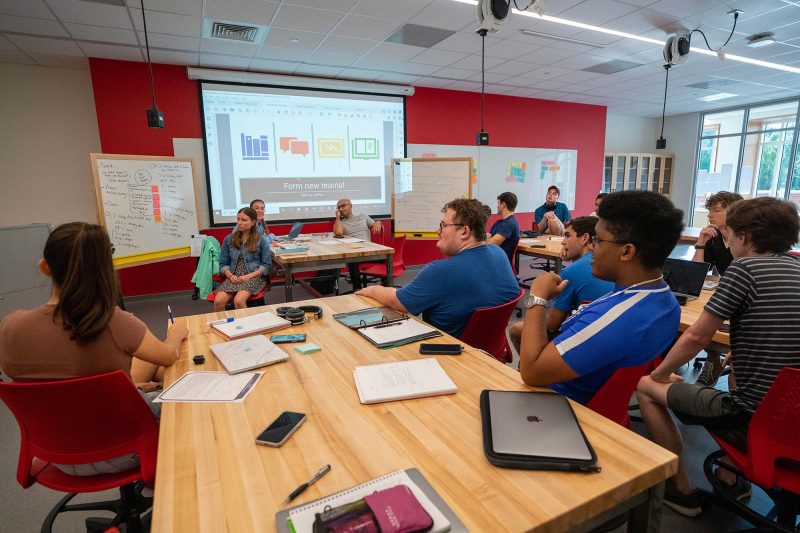
Students at work in Dr. Sirena Hargrove-Leak’s classroom in the Innovation Quad

What You'll Study

Engineering

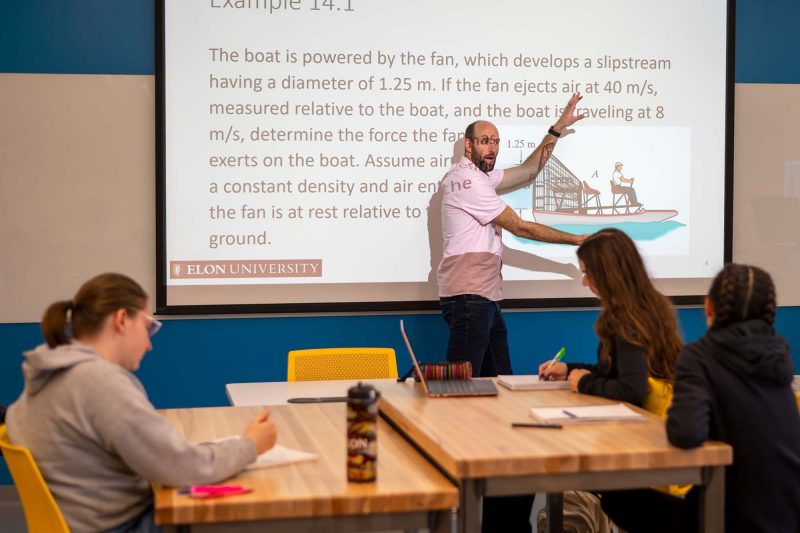
Your coursework moves through mechanics, materials, computing and design. Each year, a hands-on design experience puts that learning into practice through prototyping, experimentation, collaborative problem-solving, service learning and research.
Major Requirements & Courses

The B.S. in Engineering is a 97 credit hour program that combines a strong foundation in mathematics and the sciences with core and advanced engineering coursework, annual design experience and opportunities to explore other areas of interest.

Math & Science — 32 semester hours

Build the mathematical and scientific foundation you’ll use throughout your engineering studies, with coursework in calculus, physics and chemistry and additional study chosen from mathematics and the sciences.

  • General Chemistry I
  • University Physics I
  • University Physics II
  • Calculus I
  • Calculus II
  • Multivariable Calculus & Analytic Geometry
  • Differential Equations

Choose at least one additional course — 4 semester hours

  • General Chemistry II
  • Introductory Cell Biology
  • Cell Biology Labratory
  • Human Anatomy Lab
  • Human Physiology
  • Human Physiology Lab
  • Linear Algebra
  • Discrete Structures
  • Statistics in Application
  • Probability Theory and Statistics
  • Introduction to Environmental Science
  • Introduction to Environmental Science Lab
  • Computational Tools for Astrophysics Research
  • Modern Physics

Engineering Foundations & Design — 33 semester hours

Develop your engineering knowledge through computing, mechanics, materials and a sequence of design experiences that begins early in the program and continues through your senior year.

  • Introduction to Engineering
  • Engineering Computing with MATLAB
  • Computer Science I
  • Engineering Graphical Communication
  • Engineering Mechanics – Statics
  • Engineering Mechanics – Dynamics
  • Engineering Design for Service
  • Structure and Properties of Materials
  • Senior Engineering Design I
  • Senior Engineering Design II
  • Senior Comprehensive Evaluation

Social Sciences & Humanities — 8 semester hours

Bring economic and ethical perspectives into your engineering education by completing one economics course and one ethics course. These courses may also count toward the Âé¶¹ÊÓÆµ Core Curriculum.

  • Principles of Economics
  • Statistics for Decision Making
  • Ethical Practice
  • Environmental Ethics

Engineering Electives — 24 semester hours

Choose 24 semester hours of EGR electives:

  • (no more than four semester hours)

  • (at least four semester hours)

Your typical four-year plan

The recommended sequence shows how a full four-year course of study fits together.
You'll work with your advisor to find the right path for you.

Year One — 40 semester hours

Fall Semester

  • Calculus I
  • Writing: Argument and Inquiry or Global Experience
  • University Physics I & Lab
  • Grand Challenges in Engineering I
  • Engineering Computing with MATLAB
  • Orientation

Winter Term

  • Core Curriculum

Spring Semester

  • Calculus II
  • Global Experience ´Ç°ùÌýWriting: Argument and Inquiry
  • University Physics II & Lab
  • Computer Science I
  • Grand Challenges in Engineering II

Year Two — 38 semester hours

Fall Semester

  • Multivariable Calculus and Analytic Geometry III
  • General Chemistry I & Lab
  • Engineering Mechanics: Statics
  • Engineering Design for Service
  • Degree Elective

Winter Term

  • Core Curriculum

Spring Semester

  • Differential Equations
  • Engineering Mechanics: Dynamics
  • Structure and Properties of Materials
  • Undergraduate Research
  • Degree Elective

Year Three — 40 semester hours

Fall Semester

  • Core Curriculum
  • Degree Elective
  • Degree Elective
  • Free Elective

Winter Term

  • Core Curriculum

Spring Semester

  • Core Curriculum
  • Degree Elective
  • Free Elective
  • Free Elective

Year Four — 40 semester hours

Fall Semester

  • Senior Engineering Design I
  • Capstone Seminar (Core Curriculum)
  • Degree Elective
  • Degree Elective
  • Free Elective

Winter Term

  • Core Curriculum

Spring Semester

  • Senior Engineering Design II
  • Degree Elective
  • Free Elective
  • Free Elective

Is this program right for you?

A place for curious problem solvers.

The B.S. in Engineering fits if you want engineering breadth and are ready to point that breadth in a direction of your own. Because you’re not tied to a single concentration, the direction you build often comes from what you add through electives, your Core Curriculum choices or a minor. That direction can lead toward graduate study, but just as often it leads toward a career shaped by your own combination of engineering fundamentals and additional preparation.

Where a B.S. in Engineering might lead

There are many combinations of courses that you can add to your degree path, and a wide range of professional opportunities. A few options are here, but talk with your advisor about a combination that fits the direction you're considering.

Systems and technology

Additional study in

  • Systems modeling
  • Programming
  • Databases
  • Controls
  • Requirements Analysis

Possible role as

  • Systems Engineer
  • Systems Analyst
  • Integration Engineer

Product and design

Additional study in

  • CAD
  • Prototyping
  • Human-Centered Design
  • Materials
  • Design Portfolio

Possible role as

  • Product Development Engineer
  • Product Engineer
  • Design Engineer

Data and analysis

Additional study in

  • Statistics
  • Python
  • Data Visualization
  • Optimization
  • Machine Learning

Possible roles as

  • Engineering Analyst
  • Simulation Analyst
  • Reliability Analyst

Your Faculty

Faculty traditionally associated with the B.S. in Engineering major.