Grants in Action
Grants in Action
CATL Mini-Grants
Burlington African American Cultural Arts and History Center visit | Raj Ghoshal, Sociology & AnthropologyÂ
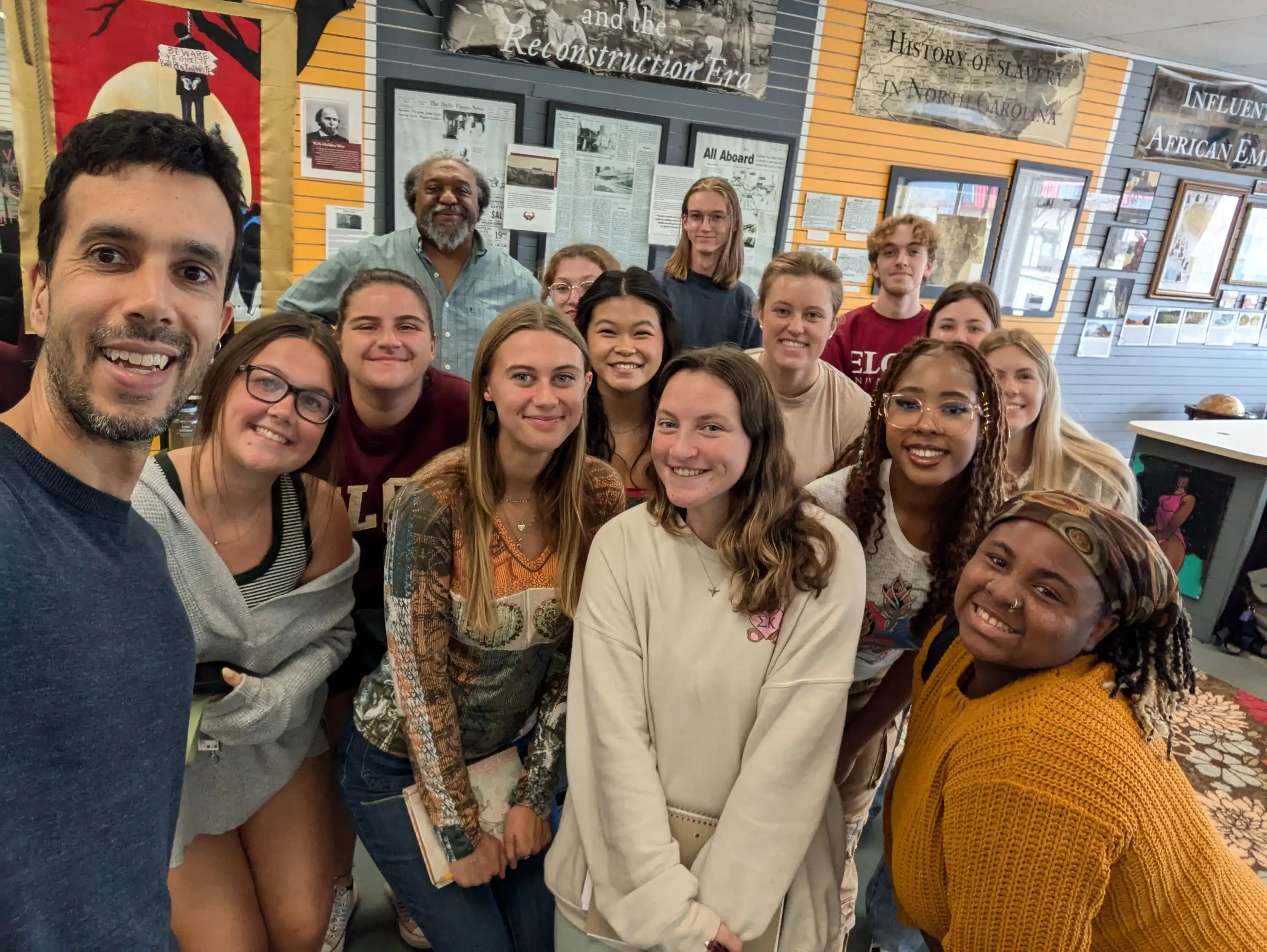
SOC 3705 students at the African American Cultural Arts and History Center in Burlington, North Carolina, during a previous visit in Fall 2024.
Raj Ghoshal’s students visited the Burlington African American Cultural Arts and History Center on January 7, 2026, where they participated in a guided tour led by James Shields. The visit connected classroom discussions about civil rights and the Black freedom struggle to local history, emphasizing how progress has depended not only on national legislation but also on community efforts and implementation. Through this experience, students explored the relationship between local activism and broader historicalÌý³¾´Ç±¹±ð³¾±ð²Ô³Ù²õ,Ìýgaining a deeper understanding of how these efforts continue to shape communities today.
Read more about Raj Ghoshal’s work here!
Narratives of Today: Empowering Students in Contemporary Writing | Negesti Kaudo, EnglishÂ
Negesti Kaudo introduced a technology-minimized approach to ENG 3150 Intermediate Creative Writing: Nonfiction and ENG 3660 Contemporary Writers, using CATL funding to provide notebooks, printed readings, and materials for hands-on creative activities. Students participated in handwritten writing exercises, collaborative brainstorming, and an artist statement collage project that encouraged them to explore the relationship between identity and their writing. Throughout the semester, approximately 90% of students chose to remain off their computers or tablets for the entirety of class, contributing to an environment of sustained engagement and collaboration. Kaudo reported that the approach encouraged experimentation, strengthened classroom relationships, and supported more intentional engagement with the writing and revision process.
Language Justice Guest Speakers | Archie Crowley, EnglishÂ
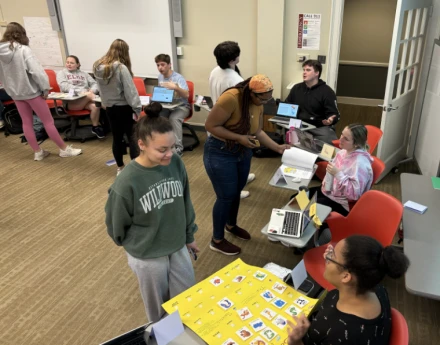
Students present their final projects during a Gallery Walk in Winter Term 2024.
Four guest speakers joined Archie Crowley’s Language in Society course to explore how language intersects with social justice, accessibility, and community identity. Students engaged with scholars and practitioners working in language access and interpretation, feminist language reform, Indigenous language revitalization, and plain language accessibility. These conversations connected classroom concepts to real-world challenges and informed students’ final projects, which involved creating public-facing educational materials about language justice issues. Crowley reported that the discussions were particularly meaningful in helping students consider how to communicate complex issues to audiences beyond the classroom.
Read more about Archie Crowley’s work here!
The Actor-Creator: A Generative and Creative Production Workshop | Kim Shively, Performing ArtsÂ
Kim Shively welcomed actor, writer, and producer Lisa Cordileone to Â鶹ÊÓƵ for a three-day intensive workshop, giving acting students hands-on experience developing their own original short film projects. Throughout the 12-hour workshop, students explored storytelling, production planning, collaborative team building, fundraising, and marketing while developing and pitching their film concepts. Rather than focusing solely on performance, the experience encouraged students to consider their roles as creators and producers within the entertainment industry. Participants left with concrete plans and next steps for bringing their creative projects to completion.
Name Tents & Participation Tracker | Robert Reardon, FinanceÂ
Robert Reardon introduced two classroom participation tools across three finance sections: numbered participation chips and reusable dry-erase name tents. Students received chips to contribute when asking or answering questions or attending office hours, creating a structured approach to encouraging classroom participation. Reardon reported a noticeable improvement in engagement, particularly in his Principles of Finance course, where questions no longer went unanswered and students were more willing to contribute their own questions. The name tents also helped him learn students’ names more quickly, strengthening opportunities for personal connections within the classroom.
SoTL Project Grants
Experimental Filmmaking as Experiential Philosophy | Nathan L. Smith, PhilosophyÂ
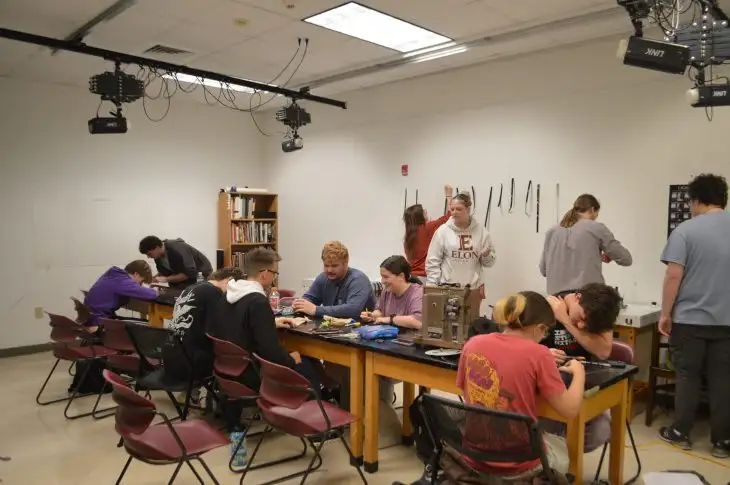
Students gather in Arts West for the “Film and Philosophy� course in November 2024
Nathan L. Smith integrated hands-on 16mm filmmaking into Â鶹ÊÓƵ’s Film and Philosophy course, using CATL funding to establish the workshop as a continuing centerpiece of the course. Working individually or in pairs, students produced experimental films examining philosophical concepts such as perception, identity, memory, and time. Throughout the process, students screened works-in-progress, received peer feedback, and refined their films before presenting their final creations alongside written reflections connecting their work to philosophical theory. Student feedback highlighted the value of this hands-on approach, with students describing the workshop as a particularly engaging and memorable part of their learning experience.
Read more about Nathan L. Smith’s work here!
Student Choice and Cross-Level Collaboration in Beginning German | Scott Windham, World Languages & CulturesÂ
Scott Windham developed a new instructional unit for German 1010/1020, which combines beginning language learners at two proficiency levels in one classroom, with the goal of increasing student choice and collaboration. The unit allows students to select five topics from six options and uses specially selected texts with overlapping themes and language structures to encourage interaction across course levels. Through collaborative reading, writing, speaking, and listening activities, students will have opportunities to learn from one another while developing their German language skills. Scheduled for implementation in Spring 2027, the project aims to increase student motivation and strengthen connections between learners at different proficiency levels.
Read more about Scott Windham’s work here!
SoTL Professional Development Grants
Teaching Asia through Role-Playing Games Workshop at ASIANetwork | Yidi Wu, HistoryÂ
Yidi Wu co-organized an interactive workshop at the ASIANetwork conference exploring how role-playing games can be used to teach Asian history. Building on her experience incorporating historical simulations into her courses, Wu introduced participants to Reacting to the Past and shorter games developed with fellow historians. Ten participants, including two Â鶹ÊÓƵ students and another Â鶹ÊÓƵ faculty member, took part in the workshop and played a simulation examining China’s potential invasion of Taiwan. The workshop received positive feedback, sparked discussions about bringing the games to other institutions, and led to an invitation for Wu to continue organizing the workshop at future conferences.
Read more about Yidi Wu’s work !
Policy in Practice: Supporting Informed & Equity-Minded Teacher Preparation | Erin Hone, Education & WellnessÂ
Erin Hone participated in the North Carolina Education Policy Fellowship Program, where she worked alongside education professionals to examine state and federal policies affecting public schools. Through the fellowship, she collaborated on an advocacy project focused on expanding high school teacher cadet programs and presented policy recommendations to legislators in Raleigh and Washington, D.C. Hone brought these firsthand experiences into her EDU 2500 Teaching Fellows Seminar, connecting classroom discussions to current policy challenges and the realities of the education system. Student feedback indicated increased curiosity and engagement with education policy, helping prepare future educators to understand and influence the systems in which they will work.
Revamping Arabic Curricula to Adjust to New Realities | Shereen Elgamal, World Languages & CulturesÂ
Shereen Elgamal attended a professional conference exploring innovative approaches to Arabic language instruction, using CATL funding to explore new ideas for curriculum development. Drawing on insights from the conference, she began revising Â鶹ÊÓƵ’s Arabic curriculum to strengthen connections between course levels, incorporate conversational dialects alongside Modern Standard Arabic, and introduce new technology-supported learning resources. In Arabic 1010 and 1020, she has incorporated additional resources that encourage students to use AI as a tool for developing their language skills rather than simply translating or generating answers. She has also begun exploring partnerships with local community organizations to create opportunities for students to apply their language skills beyond the classroom.
SoTL Dissemination Grants
“A Liberating Way to Take a Course”: Linguistically Just, Collaborative Feedback and Assessment in First-Year Writing | Catherine Bowlin, EnglishÂ
Catherine Bowlin introduced a question-based feedback model in Â鶹ÊÓƵ’s ENG 1100 and COR 1100 courses, encouraging students to take greater ownership of their writing and revision processes. Rather than relying solely on traditional instructor-directed feedback, students submit specific questions about their drafts before receiving feedback from peers or instructors, allowing them to guide the revision process. Preliminary findings from three courses suggest that this approach increases students’ confidence, ownership of their writing, and engagement with revision. Bowlin presented these findings at the 2026 Conference on College Composition and Communication, where feedback from fellow writing scholars helped inform continued refinement of the model and her ongoing research.
Read more about Catherine Bowlin’s work here!
From Classroom to Clinic: Teaching Spanish for Healthcare through Community Engagement | Bethanny Sudibyo, World Languages & Cultures
Bethanny Sudibyo developed a community-engaged Spanish for Healthcare course that gives students opportunities to apply their language skills in real clinical settings through a partnership with Open Door Clinic in Burlington. Eighteen undergraduate students participated in a service-learning experience involving eight hours of Spanish-language service, assisting with patient appointments, communication between patients and healthcare providers, and informational materials. These experiences helped students strengthen their language skills and intercultural competence while developing a deeper understanding of healthcare disparities and the needs of underserved communities. Sudibyo shared insights from the project at the Mountain Interstate Foreign Language Conference, where discussions with other educators provided new ideas and resources for developing the course and continuing her teaching research.
Read more about Bethanny Sudibyo’s work here!
Cultivating Teacher Agency: An Examination of Capstone Projects in a Master of Education Programme | Bronwyn Harris, Heidi Hollingsworth, and Nermin Vehabovic, Education & Wellness. Â
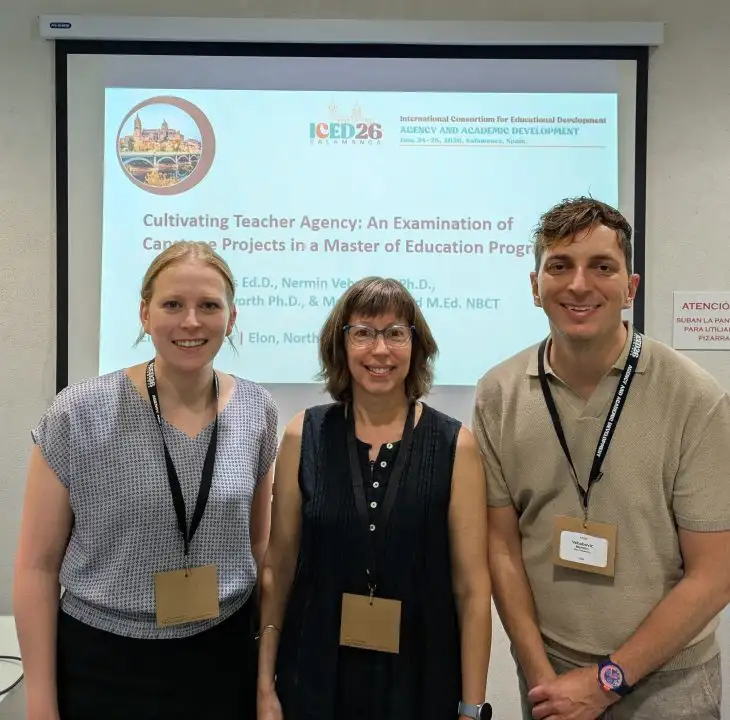
Â鶹ÊÓƵ faculty presenting their research at the International Consortium for Educational Development (ICED) 2026, held at the University of Salamanca, Spain. From left to right: Bronwyn Harris, Heidi Hollingsworth, and Nermin Vehabovic.
Bronwyn Harris, Heidi Hollingsworth, and Nermin Vehabovic examined how graduate students in Â鶹ÊÓƵ’s Master of Education programme develop teacher agency through equity-focused capstone projects. Analyzing the posters and presentations of nine M.Ed. candidates, their research explored how students combined educational theory, research, and personal reflection to make instructional decisions, develop responsive learning experiences, and advocate for equity in their professional settings. The team presented their findings at the 2026 International Consortium for Educational Development conference in Salamanca, Spain, engaging with educators from around the world on the importance of connecting academic learning to professional practice. Feedback from the conference is helping inform their ongoing research and opportunities to incorporate more authentic inquiry and student agency into undergraduate and graduate coursework.
Read more about the research here!
Analyzing Data on United States Civil War Symbols to Stimulate Social Justice Discussions in an Introductory College Statistics Course | Kirstie Doehler, Mathematics & StatisticsÂ
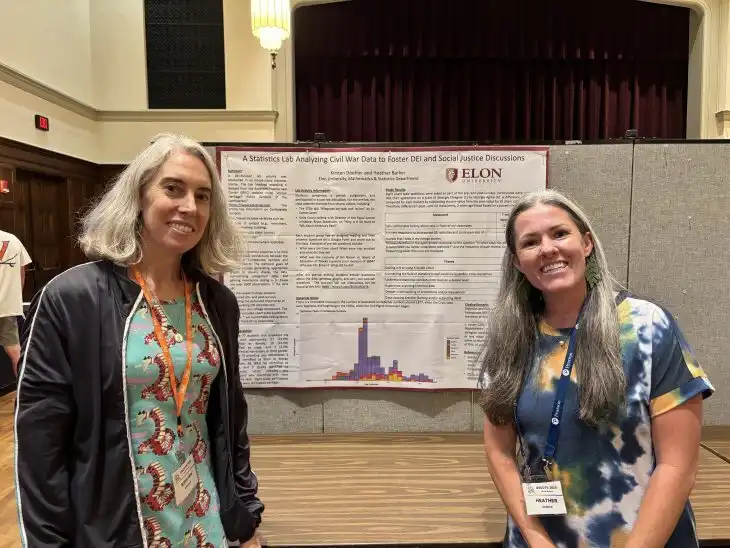
Kirstie Doehler and Heather Barker present at a poster session at the 11th United States Conference on Teaching Statistics (USCOTS) in 2025.
Kirstie Doehler, alongside colleague Heather Barker, developed a statistics learning activity using data on Confederate symbols to connect introductory statistics coursework with historical and contemporary social issues. Through the activity, students have opportunities to practice statistical analysis while considering how data can inform discussions about history, representation, and social justice. Doehler and Barker shared this work at the 2025 United States Conference on Teaching Statistics, and Doehler subsequently presented their research at the 2026 International Conference on Teaching Statistics in Brisbane, Australia. The conference provided opportunities to exchange teaching strategies with fellow educators, with Doehler identifying new ideas to bring into her classroom.
Read more about the Kristie Doehler’s work here!
“¿Sabemos o no sabemos? Promoción del bienestar y la salud mental a partir de un estudio de Elena sabe de Claudia Piñeiroâ€� / Do We Know or Do We Not Know? Promoting Well-Being and Mental Health Through a Study of Elena Knows by Claudia Piñeiro | Mayte de Lama, World Languages & CulturesÂ
Mayte de Lama incorporated mental health awareness into her SPN 3200 Reading Texts, Reading Life course through an exploration of Claudia Piñeiro’s novel Elena Knows. Using a framework developed by Â鶹ÊÓƵ’s Center for Design Thinking, students examined a character’s experiences with depression and suicide, identifying warning signs and discussing potential supportive interventions. The activity encouraged students to move beyond traditional literary analysis by connecting themes from the novel to real-world issues, developing empathy, critical thinking, and problem-solving skills. De Lama presented this approach at an international literature conference in Spain in summer 2026, exchanging ideas with other educators about integrating mental health awareness into Spanish language and literature instruction.