


Bethanny Sudibyo's Community Engagement course allows Spanish language students to get real-world experience as they build community.
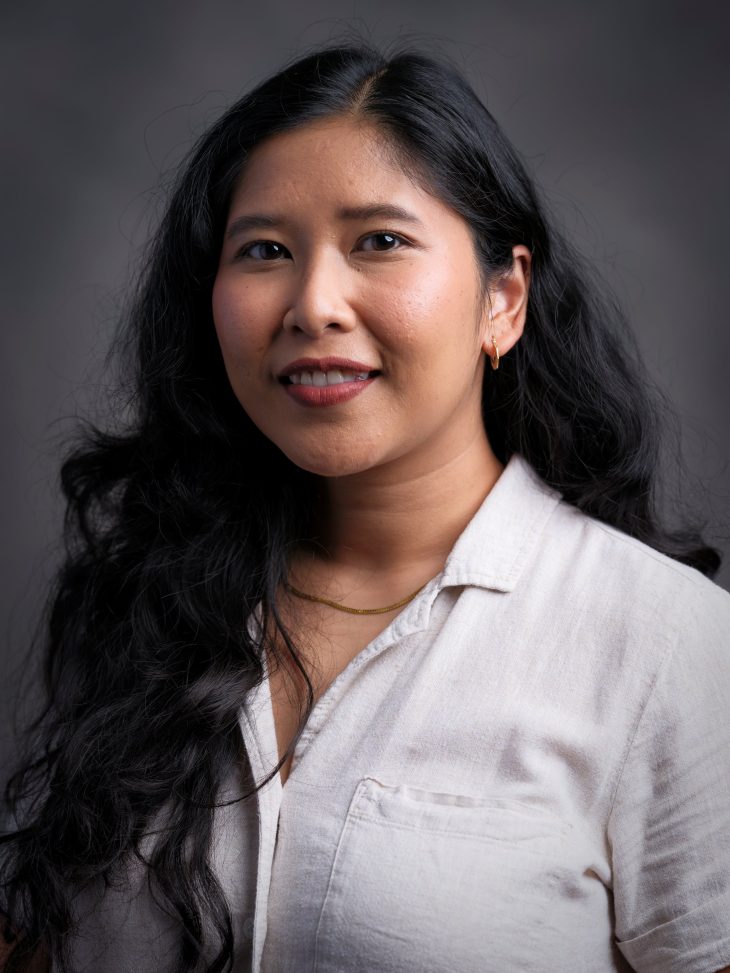
Bethanny Sudibyo, assistant teaching professor of Spanish in Â鶹ÊÓƵ’s Department of World Languages and Cultures, is building a bridge between comprehension and community.
Sudibyo’s community engagement (CE) course, Spanish for Healthcare, lets students learn and use Spanish in a practical setting through a partnership with Open Door Clinic in Burlington, North Carolina.
“It was always one of my goals to have a community engagement component,â€� said Sudibyo. “I didn’t want students to simply learn in the classroom because I think if we are thinking about language as a way to connect with people and to help the community, we should also put that into practice.â€�
The purpose of the course is to prepare students to interact with patients who may not be comfortable communicating in English in a healthcare setting. After a few weeks of preparation, students are required to volunteer for two sessions, doing tasks such as shadowing a Spanish translator, translating promotional materials into Spanish and supporting patients who may be more comfortable speaking Spanish while acting as an interpreter between the patient and healthcare professional.
“I honestly didn’t know what to expect,â€� said Hannah Nunez ’28, a public health major, who took Spanish for Healthcare in the fall of 2025. “But I really liked connecting with patients and having one-on-one conversations with them. You could tell that they were very appreciative.
It is very nerve-wracking. But honestly, they don’t care if you mess up.
It’s more so that you’re trying.â€�
The course was pitched to make language learning a more hands-on skill. Â鶹ÊÓƵ as an institution is passionate about professional experience, especially healthcare-focused programming such as nursing or physician assistant. By combining this with language learning, Sudibyo turns Spanish into a skill that can be utilized directly, strengthening practical skills and community building before students even enter the professional world. And the Open Door Clinic was open to facilitating that learning.
At first, Sudibyo was hesitant to establish a partnership due to possible ethical concerns within the medical field. However, one of her students in the first cohort of the class was a student coordinator for Open Door Clinic and was able to connect Sudibyo with the clinic, which assured her that the clinic itself was a learning space where students could build real-life experience and help patients in any capacity.
“I think the beautiful thing about the clinic is that it’s very community-centered. Everyone is volunteering,â€� said Sudibyo. “If you’re working in the healthcare professions, you’re serving a community, and you need to know who the community members are.â€�
Currently, the class is only offered at one intermediate level of Spanish in the fall semesters. In the future, Sudibyo hopes that she can get a second level to keep volunteers connected with the Open Door Clinic during the spring semester, both further building the students’ language skills and growing their connection to Â鶹ÊÓƵ’s surrounding community.
“A university as an institution can sometimes feel very disconnected with the community that it is in,� said Sudibyo. “I think it is important for students to know the stories of the people who are living around campus. It’s an important thing to bridge that gap between higher education and the community.�
For Spanish students interested in connecting their language learning with service in the local Alamance area but may be intimidated by using the language in hands-on situations, this class offers a supportive and connected environment and strongly emphasizes its two meaningful purposes: serving the surrounding community and learning to utilize the Spanish language.
“If you struggle with speaking up and speaking Spanish to other people, it can be difficult, but at the same time, it’s difficult for a reason. Learning a language is always difficult,â€� said Nunez. “It’s okay to be nervous, but you’re gonna do a lot better than you think. There’s people there supporting you.â€�