


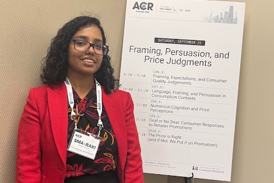
Â鶹ÊÓƵ marketing professor Smaraki Mohanty presented four studies at the Association for Consumer Research conference exploring how product size labels, ironic brand names, employee ownership and political ideology may shape what consumers think and choose.
Smaraki Mohanty, assistant professor of marketing in the Martha and Spencer Love School of Business, presented four research projects at the Association for Consumer Research conference in Chicago. The projects examined how product labels, brand names, employee ownership and political ideology may shape consumer perceptions and decisions.
One study, co-authored with Shirley Chen of Wilfrid Laurier University, examined how product size labels may influence perceptions of quality. In the study, consumers tended to rate products as higher quality when they carried distinctive labels such as “Titan� or “Grande� instead of conventional labels such as “Large� or “Double.� The findings suggest that distinctive labels may make products seem more unique, particularly when they come from larger chains.
Another project examined how ironic brand names may shape perceptions of how healthy a product is. Consumers tended to view products with names such as “Death Wish,� “Dirty� or “Brain Freeze� as less healthy, especially when the products were the kinds they generally considered healthy. The findings also suggest that descriptive packaging information, such as a list of key ingredients, may lessen the influence of an ironic name on those perceptions.
A third project, co-authored with Iman Paul of Rutgers University–Camden and Jeffrey Parker of the University of Illinois Chicago, focused on how consumers perceive products and services from employee-owned businesses. Across studies involving products such as car seats and coffee makers, as well as services and actual purchase choices, consumers tended to rate offerings from employee-owned businesses as higher quality and were more willing to choose or pay for them. One possible explanation is that consumers associate employee ownership with greater care and responsibility.
The fourth project, co-authored with Paul, Parker and Anshu Suri of University College Dublin, explored how political ideology relates to the way consumers think about their future selves. Across the studies, more conservative participants tended to report feeling more connected to their future selves and showed a stronger preference for options with future benefits, such as retirement savings and sustainable products. The findings suggest that asking consumers to think about their future selves may narrow differences in choices across political ideologies.
Mohanty joined Â鶹ÊÓƵ in 2021. Her research interests include consumer behavior, brand management and marketing strategies.