


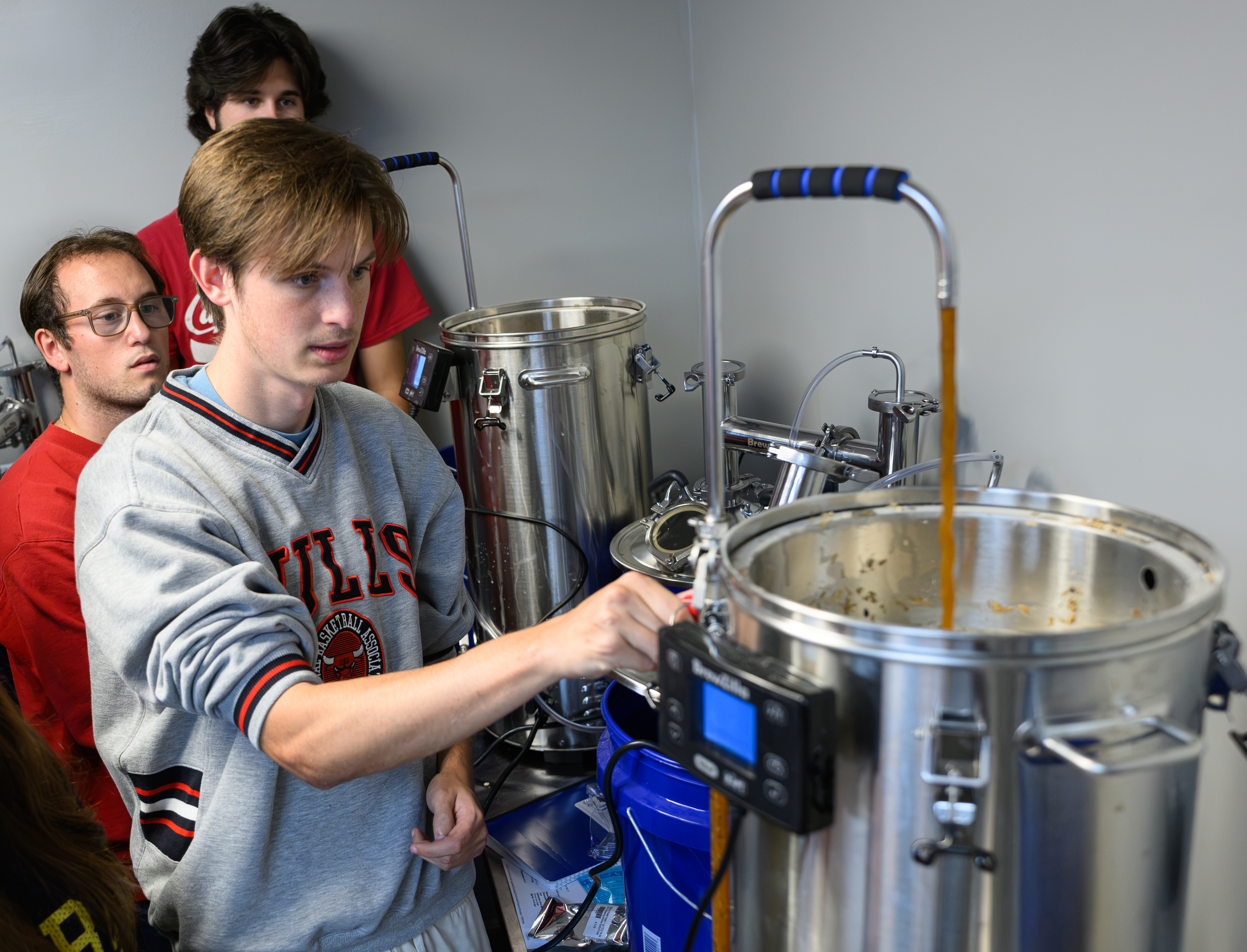
Professor Joel Karty in the Department of Chemistry is teaching a hands-on class where students learn the science and art of brewing beer.
In “The Chemistry (and Art) of Brewing Beerâ€� course, students learn chemistry and biochemistry concepts that underlie the beer brewing process, and they put their knowledge into practice by actually brewing their own beer. The course is being taught for the first time by Joel Karty, professor and chair of the Department of Chemistry and the Sydney F. & Kathleen E. Jackson Professor at Â鶹ÊÓƵ. This nonmajors course allows students, 21 and older, to fulfill their lab science requirement, which is a draw for students who otherwise would not have taken a chemistry course during their time at Â鶹ÊÓƵ.
Throughout the course, students learn chemical principles and develop chemical laboratory skills that apply to the beer brewing process, as there is a chemistry lesson behind each step. Students explore chemical concepts including solubility, density and specific gravity, acids and bases, pH, protein denaturation, carbonation, hydrolysis reactions, catalysis and enzymes. They also learn laboratory skills involving quantitative measurements, the scientific method, starch detection and ultraviolet-visible spectroscopy.
“Brewing is extremely rich in chemistry and biochemistry along with physics and biology, and it is a topic that interests a lot of students,� Karty said.
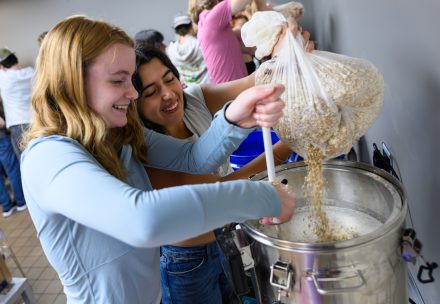
On brewing day, the students worked in eight groups of three, each brewing their own five-gallon batch of beer that began with a simple mixture of malted grains. Students use their own brewing system to first create the wort (sugary and flavorful liquid) from the malted grains, which they then boil and treat with hops. At the end of the boil, students cool the beer rapidly and transfer it to the fermenters, where they finally pitch the yeast. The students took gravity readings to measure the sugar concentration before adding yeast to begin the fermentation process. After another few weeks, the students will bottle and keg their beer.
“It’s been really cool to understand the process of what goes into making beer because there are so many different things, like the different types of yeast,â€� said Ilana Boyer ’27, a strategic communications major. “I never thought about that before, so it’s been neat to see how many steps and how long the process actually takes. I’m optimistic for how our beer will turn out.â€�
For Karty, one of the most exciting parts of the brewing day was seeing students get excited and making the connections between chemical concepts they’ve studied and the brewing process.
“I don’t think any of the students in the class have ever brewed a batch of beer before, so this will be a first for them,â€� Karty said. “I’m hoping the class removes the mystery behind the brewing process, and gives students an understanding from the perspective of chemistry and biochemistry. I’m also hoping the students gain confidence in their ability to actually brew a batch of beer that ends up being at least decent quality.â€�
Each group of students brewed a different style of beer, including an American IPA, Irish stout, an orange sour, and an American wheat.
“I’m expecting eight batches that are at least decent quality, what I would call ‘servable’,â€� Karty said. “I trust the skills that students have learned to this point. I’m looking forward to how they will turn out.â€�
Karty credits Â鶹ÊÓƵ Dining, including Ryan Moore, resident district manager and Carrie Ryan, assistant vice president for Auxiliary Services, who are letting the class use space in McEwen Dining Hall as their ‘brewing lab’.
“They have been very supportive and have spent funds to outfit the space with our electrical needs for the brewing systems,� Karty said.