


Speaking virtually with students in Assistant Professor Israel Balderas' Politics and Mass Media class, the former North Carolina governor shared firsthand insights into political campaigns, the Republican Party, and the challenges facing today's voters.

Former North Carolina Gov. Pat McCrory offered a candid assessment of modern political campaigns and President Donald Trump’s influence on the Republican Party during an Oct. 27 conversation with students in Assistant Professor Israel Balderas‘ Politics and Mass Media class.
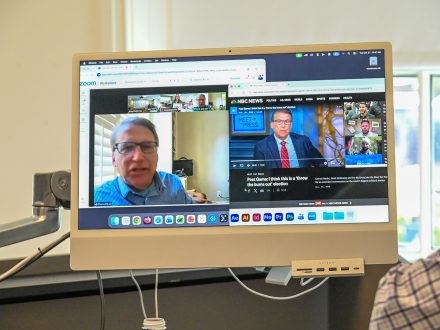
The virtual classroom discussion came just two days after McCrory appeared on NBC’s “Meet the Press,” giving students an opportunity to continue a national political conversation with a former governor who has spent more than two decades in elected office.

Drawing on that experience, including seven terms as Charlotte’s mayor and one term as governor, McCrory criticized candidates from both major political parties for emphasizing campaign promises while avoiding substantive discussions about the issues they would confront in office. He pointed to North Carolina’s U.S. Senate race, arguing that Republican Michael Whatley and Democrat Roy Cooper have focused on issues outside a senator’s direct responsibilities rather than outlining their positions on foreign policy, Social Security and other federal matters.
“What you do as a politician now to get the votes is you state what the problem is over and over, and then you say you’re going to solve it, or you say I’m going to have a plan to fix it without giving any of the details of the plan,” McCrory said.
The criticism prompted a question from Miri Pottebaum ’27, a visual communication major, who asked whether candidates could capture voters’ attention by discussing substantive national issues rather than familiar campaign themes. McCrory reasoned that candidates deliberately avoid taking positions on difficult issues because doing so could alienate independent voters and provide ammunition for political opponents.
No president, no presidential candidate in ’28, Republican or Democrat, will tell you what they plan to do on Social Security. Mark my word.
– Former North Carolina Gov. Pat McCrory
For Pottebaum, the exchange reinforced the importance of engaging with differing political perspectives, a central theme of the course.
“While he didn’t change my opinion on anything, I feel it’s always important to be in conversation with people who share different opinions,� she said. “I appreciated that he was open with us and criticized both parties.�
The former governor also reflected on his complicated relationship with Trump, whom he accompanied on the campaign trail in 2016. Responding to a question about Trump’s impact on the reputation of the Republican Party, McCrory credited the president with attracting blue-collar voters who historically supported Democrats. But he also criticized Trump’s confrontational style, contrasting it with the approach of earlier Republican leaders.
“Where he’s hurt the Republican Party is his crassness and his principles,” McCrory said, describing himself as more of a Reagan Republican. “He brought in a crassness that we’ve seen in politics, but never at the presidential level.”
Despite those criticisms, McCrory acknowledged Trump’s personal appeal and recalled finding him surprisingly courteous and attentive during private conversations. He also described how Trump’s endorsement of Ted Budd dramatically altered the trajectory of McCrory’s unsuccessful 2022 U.S. Senate campaign, illustrating the president’s considerable influence.
For Balderas, who previously covered McCrory as a television journalist for FOX Charlotte, the Zoom visit offered students an opportunity to examine the complexities of political communication beyond headlines and campaign sound bites. He structured the conversation like a gubernatorial news conference, asking each of his 12 students to develop a substantive question for the former governor.
“Whether students agree or disagree with a political figure, there is tremendous educational value in hearing directly from someone who has governed, made difficult decisions, navigated political controversies and experienced the scrutiny of the news media,” Balderas said.
Balderas praised the students for their thoughtful questions and willingness to engage directly with difficult political issues.
“They weren’t simply asking questions to fulfill an assignment,” he said. “They were genuinely engaging with some of the most consequential issues facing American politics today. These students approached that responsibility with confidence and intellectual curiosity.”